SlimTide potato resistant starch: 100 mg per capsule
Quick answer: what is the resistant starch in SlimTide?
SlimTide potato resistant starch is 100 mg per capsule, a starch that is not digested in the small intestine and is fermented in the colon instead. It is a food source for butyrate-producing bacteria. The amount is small next to the gram-scale doses used in most studies, so we grade it C and call it a supporting fiber.
Key facts
- Amount: 100 mg of potato resistant starch per capsule.
- Job in the formula: fuel for butyrate-producing bacteria, working with 211 mg of chicory root inulin.
- Our grade: C. Studies showing metabolic effects typically use several grams a day.
- Scale: 100 mg is roughly one to two per cent of typical trial doses.
- Why it is still there: a short, named active list that you can check line by line.
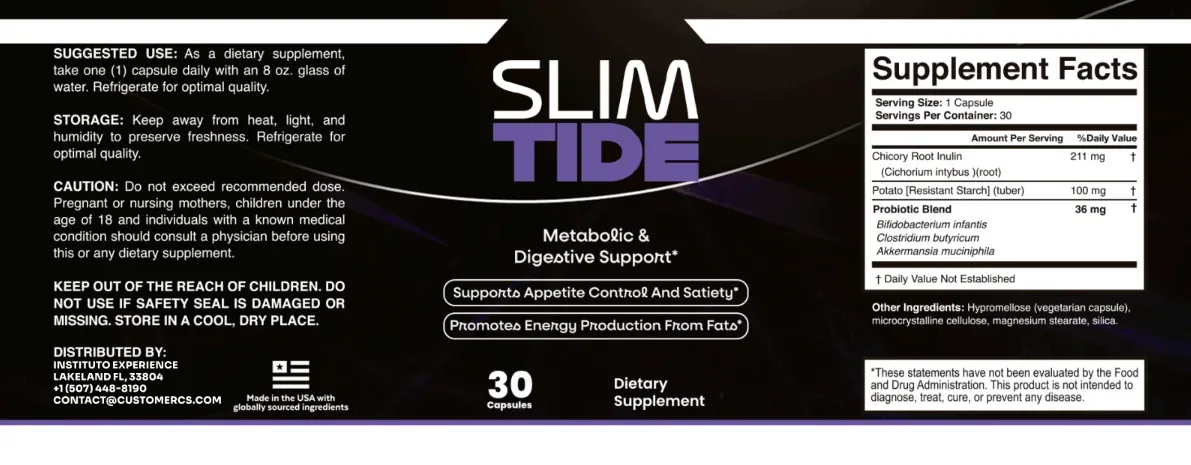
The slimtide resistant starch line is the most honest number on the panel, and also the one most often misread. It says 100 mg. It does not say a gram, and it does not say a spoonful. This page explains what the ingredient is and why the dose matters.
We use the Supplement Facts panel as our only source for amounts. Research comparisons come from the studies listed on our main page, and we say where the dose on the label does not match them.
What is potato resistant starch?
Resistant starch is starch that resists digestion in the small intestine. Instead of being broken down and absorbed, it travels on to the colon, where bacteria ferment it. SlimTide uses a potato-based form at 100 mg per capsule.
It sits beside 211 mg of chicory root inulin. Together the two fibers weigh 311 mg, and the rest of the 347 mg active list is the 36 mg probiotic blend.
What does resistant starch do in the gut?
Think of it as a slow-burning fuel for the microbes. It is a preferred substrate for butyrate-producing bacteria, and fermenting it produces short-chain fatty acids, butyrate among them. Researchers link those compounds to satiety signaling and to the way the body handles sugar.
That fits the idea behind the whole capsule. The two fibers feed the gut, and three named strains arrive alongside them: Bifidobacterium infantis, Clostridium butyricum and Akkermansia muciniphila. Clostridium butyricum is itself studied as a butyrate producer, so the pairing makes mechanical sense.
Is 100 mg of resistant starch enough?
This is where honesty matters. Trials that showed metabolic effects from resistant starch typically used several grams a day. Against that, 100 mg is roughly one to two per cent of a typical trial dose. For that reason we give the ingredient a grade of C: the research is good, but the dose on the label is under-dosed against it.
That does not make the line meaningless. It means you should read it as a supporting fiber that adds to the inulin, not as a stand-alone resistant starch product. Anyone who wants gram-scale resistant starch would need to look at a different kind of product.
What should you expect when the gut adjusts?
Fermentable fibers can cause gas and bloating in the first week or two. Inulin is usually the main cause here, but resistant starch ferments too, so both fibers play a part. The fiber amounts in this capsule are small, so many people notice little. It is still worth knowing in advance.
Give the capsule 8 to 12 weeks before you decide, and take it the same way each day: one capsule with an 8 oz glass of water, ideally in the morning before a meal. Keep the bottle in the fridge after opening to protect the live strains.
How should you judge a short label like this one?
A short list is easier to check. Every line on the SlimTide panel carries a name, and two of the three actives carry an exact dose. Compare that with a long proprietary blend, where you cannot tell how much of any ingredient is inside.
- Read the amount, then ask what dose the research used.
- Notice which lines are fiber and which are live strains.
- Remember that the finished capsule has no published trial.
- Use the 60-day money-back guarantee to test it yourself, after at least 30 days of use.
Potato resistant starch in SlimTide at a glance
| Item | What the panel and our review show |
|---|---|
| Amount per capsule | 100 mg |
| Source | Potato |
| Where it works | Colon, by fermentation |
| Our grade | C, under-dosed against trial amounts |
| Share of typical trial dose | About one to two per cent |
| Partner active | 211 mg chicory root inulin |
Frequently asked questions
How much resistant starch is in SlimTide?
Each capsule has 100 mg of potato resistant starch, read from the Supplement Facts panel.
Why is the resistant starch graded C?
Because studies that found metabolic effects used several grams a day, and 100 mg is only about one to two per cent of that. The research is sound, but the dose is small.
Does resistant starch cause gas?
It can, like other fermentable fibers, mostly in the first week or two. The amount in one capsule is small, and taking it with 8 oz of water helps.
What does resistant starch do in the SlimTide formula?
It works as fuel for butyrate-producing bacteria, alongside 211 mg of chicory root inulin in each capsule.
Our view
Potato resistant starch is a sensible companion to inulin, and the panel is open about how much of it there is. At 100 mg it supports the formula rather than carrying it. That clear label is the reason we can grade it at all.
Sources: the SlimTide Supplement Facts panel and the research papers listed on our main page, read in 2026. SlimTide is a dietary supplement, not a medicine, and the FDA has not evaluated these statements. Speak to a doctor before you start.
Last updated November 20, 2026.