Over-the-Counter Weight Loss Pills Guide: What They Can and Can't Do
What can over-the-counter weight loss pills actually do?
Over the counter weight loss pills are supplements, not approved obesity drugs, so they offer modest support at best and cannot replace diet and activity. None are FDA-approved to treat obesity. The smart move is to read the label for hidden stimulants and fillers, favour transparent dosing and third-party testing, and choose a product backed by a money-back guarantee.
- Expect modest, not miraculous — pills assist lifestyle change, they do not do the work for you.
- Read the panel, not the promise — watch for hidden stimulants and proprietary blends that hide doses.
- Stimulant-free choices exist — fibre-led formulas like SlimTide support appetite without caffeine.
Over the counter weight loss pills are one of the most searched, most crowded and most misunderstood corners of the supplement aisle, with the core phrase alone pulling around twenty-two thousand searches a month. The category promises a shortcut and mostly sells a long list of ingredients you have never heard of, at doses you cannot see, wrapped in before-and-after photos you should not believe. This guide cuts through it: what these pills realistically can and cannot do, how they are regulated, how to read a label so hidden stimulants and cheap fillers cannot hide from you, and where a stimulant-free option such as SlimTide fits for people who want appetite support without the jitters.
We publish as affiliates and we will point you to the SlimTide offer twice below, clearly labelled. But you should walk away from this article able to judge any diet pill on the shelf, ours included, because the skill of reading a label — and of testing a claim against the evidence standard the FTC requires advertisers in this category to meet — outlasts any single product recommendation.
What over-the-counter weight loss pills can and can't do
Start with the honest ceiling. Over-the-counter weight-loss pills are dietary supplements, a category the FDA regulates as food rather than as medicine, meaning no pre-market approval for effectiveness. That means, at best, some of them may offer modest help with one lever of the weight equation — nudging appetite so you eat a little less, supporting metabolism, or slowing how quickly the stomach empties so meals feel more filling. Those are real, useful mechanisms. They are also small effects that only show up when the rest of your habits are pulling in the same direction.
What they cannot do is the thing the advertising implies. No pill you can buy without a prescription reprograms your body to shed large amounts of fat while you carry on eating exactly as before; the NIH Office of Dietary Supplements review of weight-loss supplements reaches the same conclusion ingredient by ingredient. The dramatic transformations in the ads are, at best, the results of major diet and exercise changes that happened alongside the pill, and at worst pure fiction. If a product promises rapid, effortless, "melt fat while you sleep" results, that promise is the clearest signal in the whole market — it tells you the seller is willing to say things that are not true, which is all you need to know.
The productive way to think about any OTC pill is as a minor assist bolted onto the things that actually move the needle: a modest calorie deficit, enough protein and fibre, movement, and sleep. A supplement that makes it a little easier to stick to those — by taking the edge off hunger, for instance — can be genuinely worth having. A supplement sold as a substitute for them is worth avoiding.
Are OTC diet pills FDA approved? The regulation gap
Here is the fact that reframes everything else: over-the-counter diet pills are not FDA-approved to treat obesity, and in almost all cases they are not approved by the FDA at all. Dietary supplements sit in a different regulatory lane from drugs. A pharmaceutical must prove it is safe and effective before it can be sold. A supplement does not. The manufacturer is responsible for making sure its product is safe and that its label claims are truthful, and the FDA generally steps in only after a product is already on the market and something has gone wrong.
That gap is not a scandal in itself — plenty of reputable companies make good products within it. But it has two consequences you must plan around. First, "sold in stores" is not a safety certificate; a product being widely available tells you nothing about whether it works or whether its doses are sensible. Second, the burden of quality control quietly shifts onto you, the buyer. In a market where nobody checked the homework before it went on sale, the checks you can perform — transparent labelling, third-party testing, a real company behind it, a guarantee — become the whole game.
In a category where no regulator verified the product before it shipped, the label is the contract. Everything you need to protect yourself is printed on it — if you know how to read it.
Want the short version? Start with a transparent, stim-free option
If you would rather not audit twenty labels tonight, start with a product built to pass the tests below: fully disclosed prebiotic-fibre dosing, no hidden stimulants, made in a GMP-certified facility, and backed by a sixty-day money-back guarantee so the risk sits with the seller, not you.
See the Official SlimTide Offer
Affiliate link. We may earn a commission at no additional cost to you.
How to read a diet pill label like an auditor
Flip the bottle over and ignore the front. The front of the pack is advertising; the Supplement Facts panel and the ingredient list are the closest thing to a legal document you will get. Here is the order to read them in.

1. Check whether the doses are disclosed. The biggest tell in the entire category is the "proprietary blend". This is where a manufacturer lists several ingredients together under one total weight, so you can see that, say, six hundred milligrams of "Metabolic Matrix" is in there, but not how much of each ingredient makes up that total. It is legal, and it is almost always used to hide the fact that the impressive-sounding ingredients are present in tiny, ineffective amounts — a practice sometimes called "fairy dusting". Favour products that state the exact milligram dose of every active ingredient. If a company is proud of its formula, it shows you the numbers.
2. Scan for hidden stimulants. A great deal of the "energy" and appetite suppression in cheap diet pills comes from stacking stimulants, sometimes without making that obvious on the front of the pack. Learn the names: caffeine anhydrous, green tea extract standardised for high caffeine, guarana (a caffeine source), synephrine or bitter orange, yohimbine, and theobromine. There is nothing inherently wrong with caffeine, but a stack of several stimulants can mean a racing heart, anxiety, poor sleep and a rough comedown — and if they are tucked inside a proprietary blend, you cannot even see how much you are taking. If you are sensitive, on blood-pressure medication, or you take your pill in the afternoon, this section of the label matters most.
3. Read the "other ingredients" line. This is where fillers, binders and flow agents live. A few are completely normal and harmless — a capsule has to hold together. But a long list of them relative to a short list of actives can signal a product that is mostly bulking agent. If you want to go deeper on which of these are benign and which are worth a second look, our companion piece on weight loss supplement side effects and what causes them breaks down the usual suspects.
4. Look for third-party testing and a real company. Independent testing (from organisations that verify what is actually in the bottle) is a strong signal in an unregulated market. So is a genuine, findable company with a physical address and responsive support, rather than a faceless brand that exists only on one landing page. And a proper money-back guarantee is more than a marketing line — it is the company putting its own money behind the claim that you will be satisfied.
The label checklist at a glance
| On the label | Green flag | Red flag |
|---|---|---|
| Dosing | Every active shown in milligrams | "Proprietary blend" hiding amounts |
| Stimulants | Clearly stated, or none at all | Multiple stimulants stacked or hidden |
| Ingredient list | Short, readable, purposeful | Long list of unfamiliar actives at trace doses |
| Other ingredients | Few, standard capsule components | Mostly fillers relative to actives |
| Quality signals | Third-party tested, GMP facility | No testing, no verifiable company |
| Guarantee | Clear money-back terms | All sales final, no returns |
Where a stimulant-free formula like SlimTide fits
Not everyone wants a pill that works by revving them up. Stimulant-based fat burners can leave sensitive users wired, anxious and sleepless, and the effect fades as tolerance builds, tempting people into ever-higher doses. That is exactly the gap a stimulant-free approach is meant to fill, and it is where SlimTide sits.
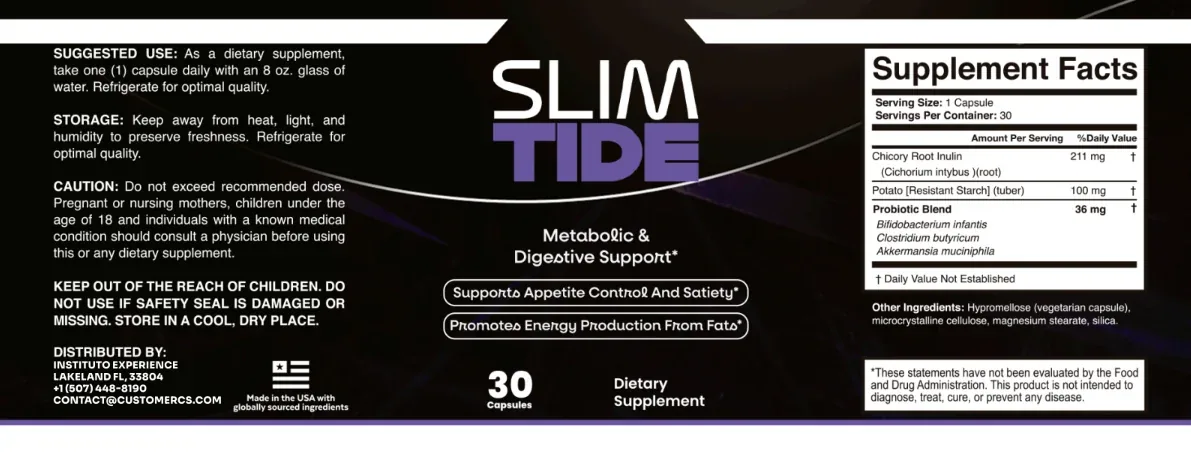
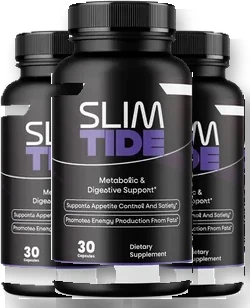
Rather than pushing your nervous system, SlimTide works on the demand side of the equation: appetite. It is built around prebiotic fibre — inulin, chicory root and resistant starch — which adds bulk, slows how quickly the stomach empties, and feeds the gut microbes involved in satiety signalling. The practical effect people are after is feeling fuller on sensible portions and reaching for fewer snacks, without a stimulant load. Because it passes the label tests above — disclosed dosing, no hidden stimulants, GMP-certified manufacturing, third-party quality practices and a sixty-day guarantee — it is a reasonable illustration of what "good" looks like in this category, whatever you ultimately choose.
We are not going to oversell it. SlimTide is a dietary supplement, not a drug; it is not FDA-approved to treat obesity and it is not intended to diagnose, treat, cure or prevent any disease, and its finished formula has not been through its own clinical trial — a limitation shared by essentially every product on this shelf. Where it earns its place is on transparency, comfort for stimulant-sensitive users, and a guarantee that lets you test it against your own appetite at low risk. To see how it stacks up against the wider field, our head-to-head roundup of the best weight loss pills of 2026 compared puts the options next to each other.
Three objections worth answering honestly
"If none of them are FDA-approved, are they all a scam?" No. "Not FDA-approved" describes the whole supplement category, including many perfectly good products; it is a statement about the regulatory lane, not a verdict on any one bottle. The scams are identifiable by other signals — impossible promises, hidden doses, no company behind them, no returns. A transparent product with disclosed dosing and a guarantee is playing a different game from a landing-page miracle cure, even though both are technically "not FDA-approved".
"Isn't a stimulant-free pill just a weaker pill?" Weaker at revving you up, yes — and that is the point. Stimulants create a feeling of doing something (elevated heart rate, suppressed hunger, energy) that people mistake for effectiveness, while the underlying benefit for weight is often small and comes with real downsides. An appetite-focused, fibre-led formula targets the behaviour that actually drives intake, without the crash, the tolerance or the sleep disruption. Different mechanism, not a lesser one.
"Why bother with a pill at all if lifestyle does the real work?" Because adherence is the hard part, and small assists to adherence compound. If a fibre-led supplement makes it easier to skip the mid-afternoon grazing that quietly wrecks your day, it is buying you consistency, and consistency is what produces results over months. The pill is not the plan. It is a tool that can make the plan easier to keep.
Common questions
Do over-the-counter weight loss pills work?
Some can offer modest help with appetite or metabolism, but none work like a prescription drug, and most of the dramatic results in advertising are unrealistic. Over-the-counter weight loss pills are supplements, not approved obesity treatments, so effects tend to be small and depend heavily on diet, activity and consistency. Treat any pill as a minor assist to lifestyle change, never a replacement for it.
Are OTC diet pills FDA approved?
No. Over-the-counter diet pills are sold as dietary supplements, which the FDA does not approve for safety or effectiveness before they reach shelves. The manufacturer is responsible for the product's safety and label claims, and the FDA mainly acts after problems appear. That is why third-party testing, transparent dosing and a money-back guarantee matter so much when you choose one.
What should I look for on a diet pill label?
Look for fully disclosed doses rather than a proprietary blend that hides amounts, a short and readable ingredient list, and evidence of third-party testing. Scan the panel for hidden stimulants such as caffeine anhydrous, synephrine or yohimbine, and check the other-ingredients line for excessive fillers. A clear label, a real company address and a guarantee are green flags; secrecy is a red one.
Which OTC weight loss pill is stimulant-free?
Stimulant-free options exist and are a good fit if caffeine makes you jittery or you take it late in the day. SlimTide is one example: it works through prebiotic fibre for appetite and satiety plus metabolic support, with no caffeine or harsh stimulants. Always confirm stimulant-free status on the actual Supplement Facts panel rather than the marketing, since some blends bury stimulants inside proprietary formulas.
Related reading
References and further reading
General information, not medical advice. These statements have not been evaluated by the Food and Drug Administration, and no dietary supplement is intended to diagnose, treat, cure or prevent any disease. Speak to a qualified healthcare professional before changing what you take.
Reading a label well is a skill you keep for life, and it is the one that protects you in a market nobody checked before it shipped. When you are ready to act on it, the simplest starting point is a product that already passes the tests above — transparent dosing, no hidden stimulants, GMP-certified manufacturing, and a sixty-day guarantee that puts the risk on the seller. You can review the official SlimTide offer below.
Affiliate link. Salimtide Evidence Room earns a commission on purchases made through it, at no extra cost to you. We are not the manufacturer.