Gut Health Supplement Ingredients: How to Spot Fillers and Flow Agents on a Label
Quick Answer: What Counts as a Filler on a Supplement Label?
Fillers and flow agents are the non-nutritive substances listed under "other ingredients", beneath the Supplement Facts panel — things like microcrystalline cellulose, magnesium stearate, silica and the capsule shell itself. They exist because powder has to be measured, pressed and packed by machines, not because anyone is trying to hide something. The useful question is not whether a label has them, but how much of the capsule they take up relative to the ingredients you are actually paying for.
- Fillers add bulk — cellulose, rice flour, maltodextrin — and can be hundreds of milligrams.
- Flow agents lubricate — magnesium stearate, silica, stearic acid — and are usually under 1% of the capsule.
- Do the arithmetic: add up the declared actives and compare that with what the capsule can hold.
Why an "other ingredients" line exists at all
Encapsulation is a manufacturing problem before it is a nutrition problem. A filling machine has to drop the same weight of powder into thousands of shells an hour, and raw botanical and fibre powders are not cooperative material. They cake in humid air, they cling to steel tooling, they flow at different rates depending on particle size, and a batch that flows badly produces capsules that vary in weight. Excipients solve those problems. They are the reason the twentieth capsule in a bottle contains roughly what the first one did.
The regulatory picture is simple enough to hold in your head. Dietary ingredients — the ones with a claimed nutritional purpose — go inside the Supplement Facts panel with an amount per serving. Everything else goes on a separate line underneath, in descending order of predominance by weight. That ordering rule is the single most useful thing on the whole line, and almost nobody uses it. If cellulose is listed first, there is more cellulose in the capsule than anything else that follows it.
None of that makes excipients invisible or unregulated. They have to be food-grade, they have to be declared, and allergen sources have to be flagged. What the line does not tell you is quantity. You get an order, not a number, and that gap is where the guessing starts.
The four excipients you will meet most often
Open a dozen bottles in this category and the same handful of names come round again. Here is what each is doing.
Microcrystalline cellulose
Purified plant cellulose, refined into a fine, free-flowing powder. It is the workhorse bulking agent of the supplement industry: chemically inert, cheap, and effectively an insoluble fibre in nutritional terms. It is there to occupy volume when the actives alone would rattle around in a half-empty shell. Nothing about it is sinister. What matters is proportion — a capsule that is mostly cellulose is a capsule that is mostly nothing.
Magnesium stearate
The magnesium salt of stearic acid, a saturated fat found in beef, cocoa butter and many everyday foods. Its job is lubrication: a thin coating that stops powder welding itself to the tooling, and its chemical, physical and lubricant properties have been characterised in the pharmaceutical literature since the 1980s. It is typically used at a fraction of one percent of the fill weight, which puts the amount in a daily capsule far below the stearic acid in an ordinary meal. It attracts more online argument than any other excipient, and we deal with that argument properly further down.
Silica
Silicon dioxide, listed as silica or colloidal silicon dioxide, works as an anticaking and free-flow agent. It keeps powder dry and mobile in the hopper, which is genuinely useful when a formula contains hygroscopic fibres that pull water out of the air. It has a long history of food use at low levels and is not absorbed to any meaningful extent.
The capsule shell
Two families dominate. Gelatin shells are made from bovine or porcine collagen, which matters if you are vegetarian or observe dietary law. Hypromellose — also written HPMC or hydroxypropyl methylcellulose — is a plant-derived cellulose alternative. The shell is not a hidden ingredient; it is simply the container, and it is the one "other ingredient" nobody objects to.
A filler is not automatically a problem. A filler you cannot account for, in a capsule whose active amounts are hidden inside a proprietary blend, is a different conversation entirely.
Want to see this applied to one real label?
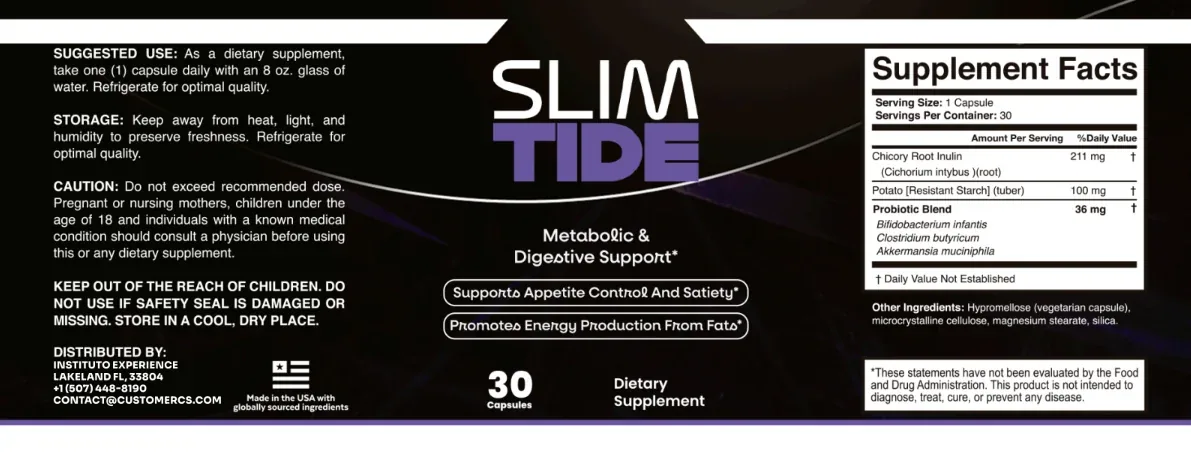
We grade the SlimTide panel ingredient by ingredient against the research that exists at that dose, and we say plainly where the evidence stops. If you have already read that and want the manufacturer's own store rather than a marketplace listing, the offer page is here.
See the Official SlimTide Offer
Affiliate link. We may earn a commission at no additional cost to you.
How much of a capsule is actually filler
This is where the arithmetic earns its keep. A size 0 vegetarian capsule — the common format in this category — holds somewhere in the region of 400 to 500 mg of a typical powder blend, depending on how dense that blend is. Add up every milligram declared in the Supplement Facts panel. The difference between that total and the capsule's capacity is, broadly, excipient.
Take the label this site is built around as a worked example. SlimTide declares 211 mg of chicory root inulin, 100 mg of potato resistant starch and a 36 mg three-strain probiotic blend, and its other-ingredients line reads: hypromellose (vegetarian capsule), microcrystalline cellulose, magnesium stearate, silica. That is roughly 347 mg of declared material inside a shell that could hold more, with cellulose making up part of the remainder and the two flow agents accounting for very little. It is an unremarkable, honest-looking line — and, importantly, it is a line you can only interpret because the panel above it discloses real numbers.
The table below sorts the usual suspects by what they do rather than by how alarming they sound.
| Excipient | Function | Typical share of a capsule | Strength of the safety concern |
|---|---|---|---|
| Microcrystalline cellulose | Bulking filler | Can be a large share when actives are low-dose | Very weak — inert purified plant fibre with long food use |
| Magnesium stearate | Lubricant / flow agent | Usually well under 1% | Weak — objection rests on isolated-cell laboratory work, not human feeding data |
| Silica (silicon dioxide) | Anticaking / free-flow | Usually around 1–2% | Weak — poorly absorbed, long-standing food additive use |
| Stearic acid | Lubricant | Under 1% | Very weak — an ordinary dietary saturated fat |
| Hypromellose (HPMC) | Vegetarian capsule shell | The shell itself | None nutritionally; relevant only to dietary preference |
| Gelatin | Animal-derived capsule shell | The shell itself | None nutritionally; matters for vegetarian, halal and kosher diets |
| Rice flour or maltodextrin | Cheap bulking filler | Can dominate a low-dose capsule | Weak as a safety matter, meaningful as a value matter |
| Titanium dioxide | Whitening colour, cosmetic only | Trace | Contested — no longer permitted as a food additive in the EU, still permitted in the US |

Reading gut health supplement ingredients in the right order
Most people read a label from the top and stop when the marketing copy runs out. A more useful order runs almost backwards, because the questions that decide whether a product is worth buying are answered in a different sequence from the one the packaging presents.
- Start with the amounts, not the names. An ingredient with a famous name at a token dose is worth less than an unglamorous one at a researched dose.
- Check for a proprietary blend. If several ingredients share one total, you cannot tell how the total is divided, and neither can anyone else outside the factory.
- Count the servings, not the capsules. "Two capsules" as a serving halves the number of days in a bottle and doubles the real cost per day.
- Then read the other-ingredients line for allergens, animal-derived shells, unnecessary colours and evidence that the capsule is mostly bulk.
- Finish with storage and seal wording, which tells you what the manufacturer thinks is fragile.
Applied consistently, that sequence sorts the field faster than any amount of front-of-bottle claim reading. It is also the honest reason we keep saying that comparing gut health supplement ingredients is a numbers exercise rather than a vibes exercise. The full panel behind this product, with our grade for each entry, is on the SlimTide ingredient breakdown.
Where the concern is real, and where it is overblown
The measurable effect of magnesium stearate is on manufacturing behaviour rather than health: laboratory work has shown a delay effect on tablet dissolution in acidic medium at high levels, which is a formulation variable, not a safety finding at the amounts used in a capsule. MedlinePlus is a reasonable first stop for anyone worried about a specific excipient.
The magnesium stearate argument deserves a straight answer, because it is repeated so confidently. The claim that it suppresses immune function traces back to laboratory work in which stearic acid was applied to isolated immune cells in culture. That is a legitimate experiment, but cells in a dish are not a person eating a capsule, and the exposure conditions bear no resemblance to swallowing a fraction of a milligram alongside food. There is no body of human feeding evidence showing harm at supplement amounts. Equally, we are not going to pretend there is a body of evidence showing benefit — it is a processing aid, and the honest summary is that the case against it is much weaker than the internet suggests.
Two concerns are more defensible. The first is dilution: a capsule where bulking agent outweighs everything else is poor value, and that is a commercial judgement you can make with confidence from the label alone. The second is unnecessary cosmetic additives. Colours and whiteners exist to make a capsule look uniform, they contribute nothing, and in the case of titanium dioxide the regulatory position now differs between the EU and the US. Skipping products that use it costs you nothing.
Allergen and dietary flags are the third real category. A gelatin shell rules a product out for a vegetarian; a dairy-derived carrier in a probiotic matters to someone avoiding lactose; wheat-derived starch matters to someone avoiding gluten. Those are not health scares, they are compatibility facts, and they belong at the front of your reading rather than the back.

What a clean other-ingredients line cannot tell you
This is the limit worth stating plainly, because "clean label" has become a selling point that does more work than it deserves. A short excipient list tells you the manufacturer used few processing aids. It tells you nothing at all about the four things that actually determine whether a supplement does anything.
It cannot tell you whether the active ingredients are present at the amounts used in published research. A capsule can be free of stearates, free of colours, entirely vegetarian, and still contain a fifth of the fibre dose that trials used. It cannot tell you whether the raw materials were identity-tested on arrival, or whether the botanical named on the front is the species in the drum. It cannot tell you what the live organism count will be at the end of shelf life rather than at manufacture — a question that depends far more on how the bottle is handled than on what is listed beneath the panel, which is why we wrote up how storage conditions affect potency separately.
And it cannot make the product a treatment. Nothing on an other-ingredients line, however short and however plant-derived, changes what a dietary supplement is. These are foods in capsule form. They are not intended to diagnose, treat, cure or prevent any disease, and a label that implies otherwise has left the ground where the evidence sits. For most formulas in this category, including this one, there is research on the individual ingredients and no published trial on the finished combination — and no excipient choice changes that.
A five-minute label check you can actually use
If you want one repeatable routine rather than a set of principles, this is it. It works in a shop aisle, on a phone, or against a photo of a panel.
- Photograph the Supplement Facts panel and the line beneath it together, so the two can be compared later.
- Total the declared milligrams and ask whether that plausibly fills the capsule you are holding.
- Flag any proprietary blend and treat every ingredient inside it as an unknown quantity until proven otherwise.
- Scan the other-ingredients line for the first name only — predominance order means the first entry is the biggest.
- Note the shell material and any allergen statement before anything else if you have a dietary restriction.
- Ignore front-of-bottle adjectives entirely. "Advanced", "clinical strength" and "pure" are not defined terms.
Do that for three products in the same category and the differences become obvious in a way that no amount of marketing copy will make them. Applied to a real panel, the exercise looks like our walk through the SlimTide ingredients and the dose beside each one, where the other-ingredients line lists hypromellose, microcrystalline cellulose, magnesium stearate and silica. And once you can read a panel, the next question is how much weight the research behind it deserves — a hierarchy we set out in how to judge supplement evidence. It is the least glamorous skill in supplement buying and by some distance the most useful one, whether you are shortlisting the best gut health supplement for your own routine or simply trying to work out why two bottles with near-identical front labels behave so differently on paper.
Common questions
What is the difference between a filler and a flow agent?
A filler adds bulk so that a small quantity of active powder fills a capsule consistently, and it is usually present in tens or hundreds of milligrams. A flow agent is a lubricant or anticaking agent that stops powder sticking to machinery, and it is usually present at well under one percent of the capsule. Microcrystalline cellulose is a typical filler; magnesium stearate and silica are typical flow agents.
Is magnesium stearate bad for you?
The evidence for harm at the amounts used in capsules is thin, and so is the evidence usually cited against it. The best-known objection traces back to laboratory work on isolated immune cells rather than to human feeding studies, and the quantity in a capsule is a small fraction of the stearic acid people already eat in ordinary food. It is a reasonable thing to prefer to avoid, but it is not a demonstrated hazard.
Does a shorter other-ingredients list mean a better supplement?
Not on its own. A short list tells you the manufacturer used few excipients; it says nothing about whether the active ingredients are present at the amounts used in research, whether the identity of each raw material was verified, or whether the finished formula has ever been tested. A clean line is a nice-to-have that sits well behind dose and disclosure in importance.
How can I tell if a capsule is mostly filler?
Add up the milligrams listed in the Supplement Facts panel and compare that total with the capsule size. A common size 0 vegetarian capsule holds roughly 400 to 500 mg of typical powder. If the declared actives come to well under half of that and the other-ingredients line leads with cellulose or rice flour, most of what you are swallowing is bulking agent.
References and further reading
- NIH Office of Dietary Supplements — dietary supplements: what you need to know
- NCCIH (NIH) — dietary and herbal supplements
- Mayo Clinic — drugs and supplements reference
- Harvard T.H. Chan School of Public Health — The Nutrition Source: vitamins and supplements
- Phadke DS, Collier JL — Chemical, physical and lubricant properties of magnesium stearate (Journal of Pharmaceutical Sciences, 1988)
General information, not medical advice. These statements have not been evaluated by the Food and Drug Administration, and no dietary supplement is intended to diagnose, treat, cure or prevent any disease. Speak to a qualified healthcare professional before changing what you take.
Label literacy is free, and it filters more products than any single buying rule. If you have run the arithmetic on this panel, decided the doses stack up for a best gut health daily supplement slot in your routine, and want to know where to buy it from the manufacturer's own store rather than a resale listing, the official offer page is below.
Affiliate link. Salimtide Evidence Room earns a commission on purchases made through it, at no extra cost to you. We are not the manufacturer.